
Breeding
Sex ratios
- One male with two or three females generally gives high fertility. In colony pens, one male to three females is enough and reduces fighting. Pair matings in cages also give good fertility [1].
- Fertility drops markedly in older birds [1]; Michigan State notes it falls considerably after one year of age [6].
Sexing by plumage
- Wild-type (pharaoh) males develop rusty brown throat and breast feathers; females have light tan breasts with black speckles [1]. The difference appears around 3 weeks of age [10][14].
- Some varieties cannot be sexed by feathers. A breeder's genetics guide lists English White, Tibetan and Rosetta as not feather-sexable [14].
- Sex-linked crosses: breeders cross roux males with non-roux females to get chicks that can be sexed at hatch for one generation [14]. The Japanese commercial industry in Toyohashi uses sex-linked brown plumage for auto-sexing [10].
Sexing by vent
- Mature males have a cloacal (foam) gland, a bulb on the upper edge of the vent that secretes white foam. It can be used to judge a male's breeding condition [1].
Selection and records
- Record hen numbers on eggs, incubate in groups, and mark chicks at hatch. Wing bands identify birds of any age; oil paint on back feathers or nail polish on toes works temporarily [1].
- Each hen tends to lay eggs with her own characteristic shell pattern, which can help identify layers [1][10].
Inbreeding
- Avoid mating close relatives: inbreeding increases abnormalities and lowers reproduction [1].
- In a classic University of California study, successive full-brother-sister matings caused complete loss of reproductive fitness by the third generation (inbreeding coefficient 0.5), mainly through lower hatchability, viability and fertility [15].
- The same study kept its non-inbred control line at an effective population of about 125 birds, limiting inbreeding to less than 0.5% per generation [15]. A small homestead can't match that, so bringing in unrelated birds from time to time, and keeping records, is the practical defense.
Incubation and brooding
Before incubation
- Collect eggs several times a day [1] (at least three times daily per UC ANR [2]).
- Hold hatching eggs cool, not cold. NSW suggests about 15°C (59°F) and says a household refrigerator is too cold; set eggs within a week for best results [1]. UC ANR gives maximum storage temperatures by storage time: 70°F for 1 day, 65°F for 2–4 days, 60°F for 5–10 days, 55°F beyond 10 days, never below 50°F [2].
- Store eggs large end up [2]. Don't wash hatching eggs; clean slightly soiled ones with fine sandpaper [1][2].
- Cracked eggs hatch poorly or not at all [1]. Quail shells are fragile, and their colored shells make candling hard [1].
- Thoroughly clean and disinfect the incubator after every hatch [1].
Incubation settings (sources differ slightly)
| Setting | Mississippi State [5] | NSW DPI [1] | UC ANR [2] |
|---|---|---|---|
| Incubation length | 17 days | 17–18 days | 17–18 days |
| Forced-air temperature | 100°F | 99.5°F ± 0.5 (37.5°C) | 99.5–100°F |
| Still-air temperature | add 2–3°F (about 102°F, measured at top of eggs) | 101°F week 1, 102°F week 2, never above 103°F | 102–103°F |
| Humidity, setting | 85–86°F wet bulb (about 58–60% RH) | 86°F wet bulb (about 60% RH) | 82–86°F wet bulb |
| Turning | at least 4–6 times daily | every 2–4 hours (automatic); hand-turn at least 3, preferably 5 times daily | every 2–4 hours; by hand 3+ times daily |
| Stop turning ("lockdown") | after day 15 | day 14 | when moved to hatcher |
| Humidity, hatching | 90°F wet bulb (65%+ RH) | 90°F wet bulb (about 70% RH); hatcher at 99°F | 90–92°F wet bulb; hatcher at 98.5°F |
Where sources disagree: lockdown day (14 vs 15) and the exact temperature (99.5°F vs 100°F). Michigan State also says not to turn after day 14, and notes that hatch usually comes on day 17 but can range from day 14 to day 19 [6]. Always follow your incubator manual first; all three sources say so [5][1][2].
Other incubation tips
- Set eggs large end up or on their side, never small end up [2][5].
- Ventilation needs rise as embryos grow; open vents more near hatch [2][5].
- Candle at 7–10 days and again at transfer to the hatcher; use a strong light because quail shells are pigmented [2].
- Total moisture loss by hatch should be about 15% of egg weight [2].
- Keep the hatcher closed during hatching [1][5].
- To stop newly hatched chicks from sprawling (splayed legs), crowd the eggs together or line the hatching tray with cheesecloth [1].
- Domestic coturnix rarely go broody; bantam hens can hatch quail eggs [1].
Hatch timeline (built from the sources above)
| Day | What happens |
|---|---|
| Before day 0 | Clean and run the incubator for at least 24 hours to check temperature [2] |
| Day 0 | Set clean, uncracked eggs, large end up [1][2] |
| Days 7–10 | First candling [2] |
| Day 14–15 | Candle again, remove clears and cracked eggs, stop turning, raise humidity ("lockdown") [1][5] |
| Days 17–18 | Hatch [1][2]; occasionally as early as day 14 or as late as day 19 [6] |
Brooder setup
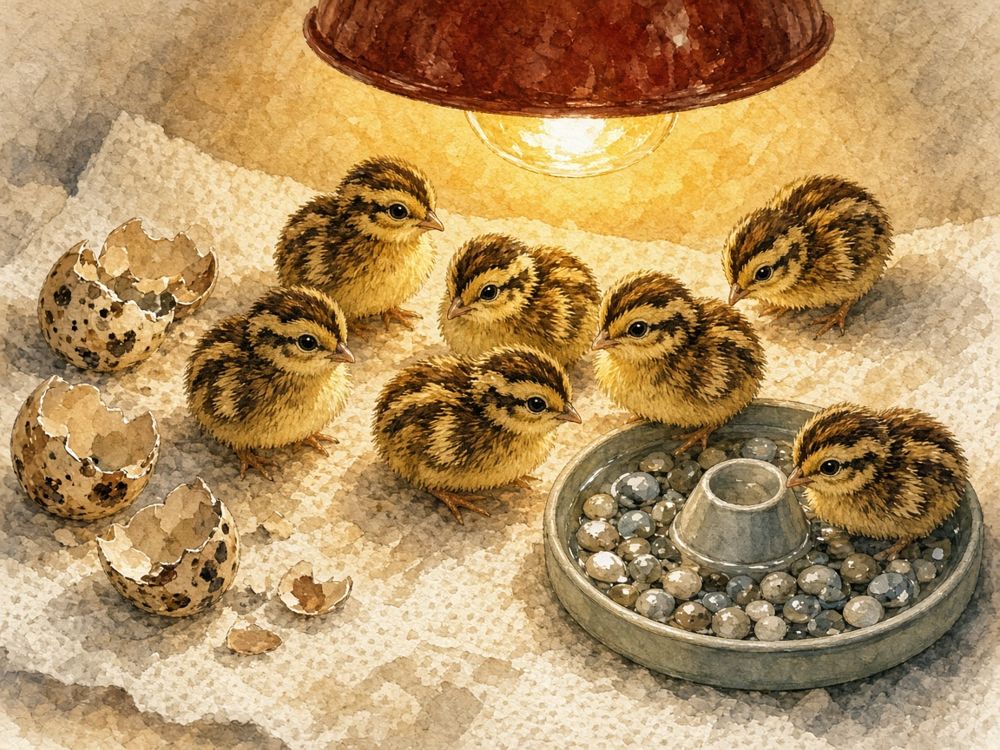
- Use rough paper over the litter for the first week; chicks spraddle on smooth paper. Paper towels beat newspaper [1].
- Sprinkle feed on the paper so chicks find it [1].
- Use marbles or pebbles in waterers for the first week [1].
- Hang the heat source 30–46 cm (12–18 in) above the floor and measure temperature at chick level [1].
- Protect chicks from drafts, especially at night [1].
- Read the chicks: crowding under the heat means too cold; settling just outside the hottest spot means about right; avoiding the heat entirely means too hot [1][2].
Brooder temperature schedule
| Week | NSW DPI [1] | UC ANR [2] |
|---|---|---|
| 1 | about 35°C (95°F) | 95°F (35°C) |
| 2 | about 31.5°C (89°F) | about 90°F |
| 3 | about 28°C (82°F) | about 85°F |
| 4 | heat usually no longer needed once fully feathered (3–4 weeks) | about 80°F, continuing down to room temperature |
NSW recommends lowering the temperature about 3.5°C per week; UC ANR lowers it about 5°F (2.8°C) per week and notes quail seem to need slightly higher brooding temperatures than pheasants. Weeks 2–4 above are calculated from those weekly reductions. Chicks need supplementary heat for about 3–4 weeks [1]. Young birds can move from the brooder to adult cages or floor pens at about 4 weeks [6].
Sources for this page
Numbers in brackets throughout the page point to these sources. Many are university extension publications, government agencies or peer-reviewed studies.
- Randall, M. & Bolla, G. (2008). Raising Japanese quail (Primefact 602, 2nd ed.). NSW Department of Primary Industries. https://www.dpi.nsw.gov.au/__data/assets/pdf_file/0005/145346/Raising-Japanese-quail.pdf (full text also reprinted at https://www.thepoultrysite.com/articles/raising-japanese-quail-1)
- Ernst, R. A., Woodard, A. E., Vohra, P. & Cardona, C. Raising Game Birds (ANR Publication 8155). University of California Agriculture and Natural Resources. https://ucanr.edu/sites/default/files/2018-07/286690.pdf
- Mississippi State University Extension. Important incubation factors. https://extension.msstate.edu/agriculture/livestock/poultry/important-incubation-factors
- Varghese, S. K. Japanese Quail (Coturnix) (Extension Bulletin E-1069). Michigan State University Extension. https://sanweb.lib.msu.edu/DMC/Ag.%20Ext.%202007-Chelsie/PDF/e1069.pdf
- Mizutani, M. (2003). The Japanese Quail. In The Relationship Between Indigenous Animals and Humans in APEC Region. APEC. https://www.apec.org/docs/default-source/publications/2003/12/the-relationship-between-indigenous-animals-and-humans-in-apec-region-2003/toc/quail.pdf
- Southwest Gamebirds (breeder). Plumage Variations in Publicly Available Japanese Quail and their Underlying Genetics. https://southwestgamebirds.com/pages/genetics
- Sittmann, K., Abplanalp, H. & Fraser, R. A. (1966). Inbreeding depression in Japanese quail. Genetics 54(2):371–379. https://doi.org/10.1093/genetics/54.2.371