
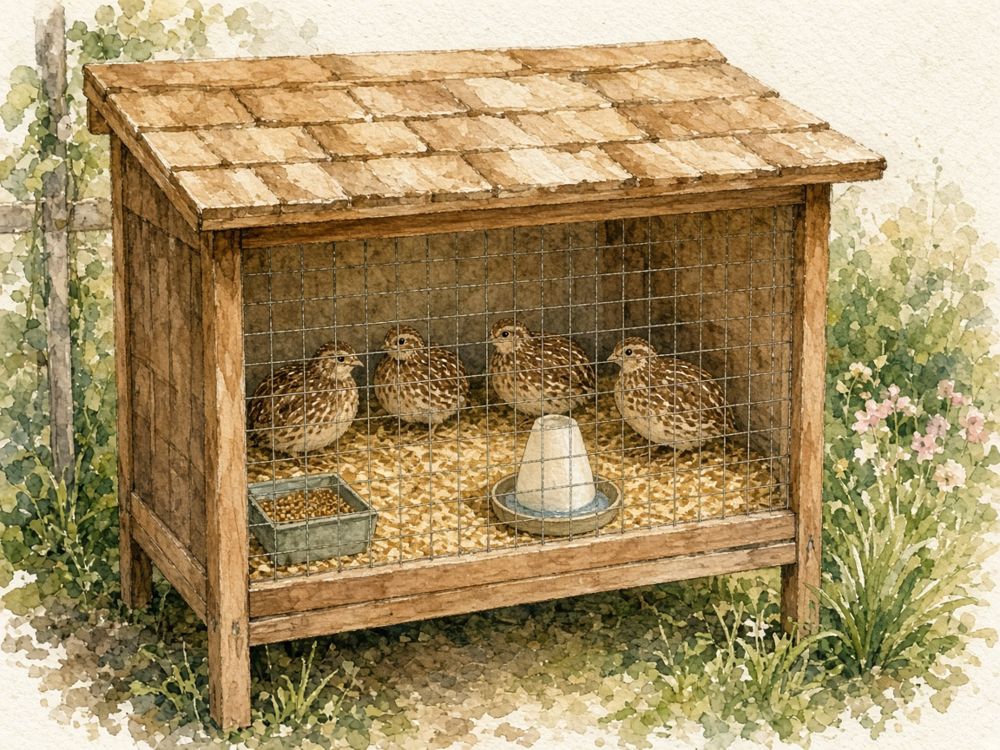
Cages, hutches and aviaries
- Match housing to purpose. Small pair or colony cages suit egg and meat production; hobbyists may prefer aviaries or deep-litter floor pens that don't need frequent cleaning [1][7].
- Birds kept for breeding, eggs or meat perform better in cages; floor rearing suits hobby or dog-training birds [6].
- In community floor pens, hens often won't build a nest and will hide eggs in the litter, which is one reason egg producers prefer cages [1][7].
- Quail kept in a garage-type room need insulation, good ventilation, no drafts and protection from cats, rodents and hawks [1].
- Coturnix are not good fliers when raised in close confinement [2], but they do flush straight up when startled (see "Roof height" below).
Space per bird (sources disagree widely)
| Source | Space per adult bird | Context |
|---|---|---|
| Michigan State Univ. Extension [6] | 16–25 sq in | Cages; more space indoors to cut odor |
| Texas A&M (1974) [7] | 20 sq in; 25–30 sq in indoors | Cages/pens; extra space reduces odor |
| NSW Dept. of Primary Industries [1] | 145 cm² (about 22.5 sq in); 125 cm² (about 19.4 sq in) on wire floors | Cages; a 13 × 20 cm cage holds two birds |
| Iowa lab guide [9] | 27 sq in (12 birds in an 18 × 18 in cage) before lay; more once laying starts | Laboratory colonies |
| UC Agriculture and Natural Resources [2] | 1/2 sq ft (72 sq in) | Wire-floor pens |
| Virginia Tech Extension [8] | 1 sq ft inside, plus 4 sq ft in an outdoor run | Small-scale/backyard housing |
The low end (about 16–30 sq in) comes from commercial and laboratory cage guides; the high end (½ to 1 sq ft or more) comes from backyard and pen guides. Virginia Tech notes there is very little research on space for small-scale flocks and that "you can never provide too much space" [8]. Overcrowding lowers growth and fertility, raises mortality and can trigger cannibalism [9].
Feeder and water space
- Adult coturnix need about ½–1 inch of feeder space per bird [7][6] (1.25–2.5 cm per NSW [1]).
- Provide at least ¼ inch (0.6 cm) of water trough space per bird [1]; Virginia Tech suggests 1 linear inch per bird for small birds such as quail [8].
- Nipple drinkers and cups work for adults: one nipple or cup per 5 birds [1].
Flooring and wire
- NSW recommends 7 mm square welded mesh for secure footing, fewer leg injuries and so chicks can't escape [1]. Michigan State suggests ½ × 1 inch welded wire for cages [6], and Texas A&M recommends ½-inch hexagonal mesh (1-inch is acceptable) for pens [7].
- Cover wire floors with coarse paper for the first week or so for chicks to prevent leg injuries [1]. Quail brooders need finer hardware cloth than chickens [2].
- Feather picking and other cannibalism can occur when coturnix are kept on wire [1].
- Floor pens use litter (wood shavings, sawdust or sand) 5–10 cm (2–4 in) deep [1].
Roof height and head injuries
- Startled coturnix fly straight up. NSW recommends a solid metal or plywood cage roof to reduce head injuries [1]. (See "scalping" on the Health page.)
Ventilation
- Brooder rooms must be ventilated to keep ammonia from building up; if you smell ammonia or see wet litter, ventilation is inadequate [2].
- In winter, moisture plus cold leads to condensation and frostbite; extension advice for chickens is to keep air moving and manage manure to control moisture [42].
Lighting
- Laying hens need 14–18 hours of light per day for top production and fertility, so Indiana keepers will need supplemental light in fall, winter and spring [1][6].
- Meat birds and non-breeding males can be held on about 8 hours of low-intensity light; that isn't enough to bring on sexual maturity, so they fight and mate less and fatten faster [1].
- For chicks, one lab guide uses continuous light for the first two weeks, tapering to 16 hours by week four [9]. UC ANR suggests a 16-hour day at about 20 lux for brooding pens during the first week [2].
- Bright brooder lights increase activity and picking; dim light (1–2 foot-candles at the feeders) reduces it [2].
- Chicken extension advice for winter lighting is to add light in the morning before sunrise rather than after sunset, so birds aren't caught in sudden darkness [42].
Predators
- Protect quail from cats, dogs, rats, raccoons and hawks [1][7].
- UC ANR describes predator "signatures": weasels and rats often kill many birds and pile them; raccoons tend to take heads; rats may pull birds into burrows and make young birds and eggs vanish [2].
- Rodents also carry disease and external parasites, so rodent control is part of biosecurity [2].
Indiana winter
- Chicken extension guidance: most poultry are comfortable between 60 and 75°F; add supplemental heat when coop temperatures fall below 35°F [42]. (Quail-specific winter thresholds were not found in extension sources.)
- Seal drafts but keep ventilation; use only heat lamps approved for livestock, never hang a lamp by its cord, use a bulb cage, keep wires away from water and litter, and don't run power through extension cords long-term [42].
- Keep water from freezing with heated founts or bases; heated dog dishes should be partly covered so birds can't step in or drown [42].
- Birds eat more in cold weather, up to 25% more for chickens [42].
Indiana summer
- Signs of heat stress in chickens: panting, wings held away from the body, then lethargy and pale skin in danger cases. Prevention is shade, cool clean water and airflow [43].
- In hot weather layers eat less; NSW suggests raising layer-diet calcium to as much as 3.5% so shells stay strong [1].
- Summer needs extra attention to odor and sanitation in cage setups [9][7].
- Caution: some chicken heat advice (such as shallow wading pans) needs adapting for quail, since quail chicks can drown in open water [1].
Sources for this page
Numbers in brackets throughout the page point to these sources. Many are university extension publications, government agencies or peer-reviewed studies.
- Randall, M. & Bolla, G. (2008). Raising Japanese quail (Primefact 602, 2nd ed.). NSW Department of Primary Industries. https://www.dpi.nsw.gov.au/__data/assets/pdf_file/0005/145346/Raising-Japanese-quail.pdf (full text also reprinted at https://www.thepoultrysite.com/articles/raising-japanese-quail-1)
- Ernst, R. A., Woodard, A. E., Vohra, P. & Cardona, C. Raising Game Birds (ANR Publication 8155). University of California Agriculture and Natural Resources. https://ucanr.edu/sites/default/files/2018-07/286690.pdf
- Varghese, S. K. Japanese Quail (Coturnix) (Extension Bulletin E-1069). Michigan State University Extension. https://sanweb.lib.msu.edu/DMC/Ag.%20Ext.%202007-Chelsie/PDF/e1069.pdf
- Texas A&M University (1974). Japanese Quail (Coturnix): Care, Management, Propagation. https://hdl.handle.net/1969.1/92988
- Jacobs, L. & Clauer, P. J. Small-scale Poultry Housing (APSC-186). Virginia Cooperative Extension / Virginia Tech. https://www.vtdairy.dasc.vt.edu/content/dam/pubs_ext_vt_edu/2902/2902-1092/APSC-186.pdf
- Raising Japanese Quail in the Laboratory. Iowa Science Teachers Journal 5(3). https://scholarworks.uni.edu/istj/vol5/iss3/12
- Carlson, C. & Lochner, H. Caring for chickens in cold weather. University of Minnesota Extension. https://extension.umn.edu/agriculture/animals-and-livestock/poultry/caring-for-chickens-in-cold-weather
- Wright, A. Managing Backyard Chickens During Periods of Extreme Summer Temperature. University of Arizona Cooperative Extension, via Extension Poultry. https://poultry.extension.org/articles/poultry-management/managing-backyard-chickens-during-extreme-summer-temperatures/