Coturnix at a glance
What a coturnix quail is
- The Japanese quail is a small ground bird in the order Galliformes, genus Coturnix, species japonica. Wild birds migrate across Japan, Korea, eastern China, Mongolia and Sakhalin [10].
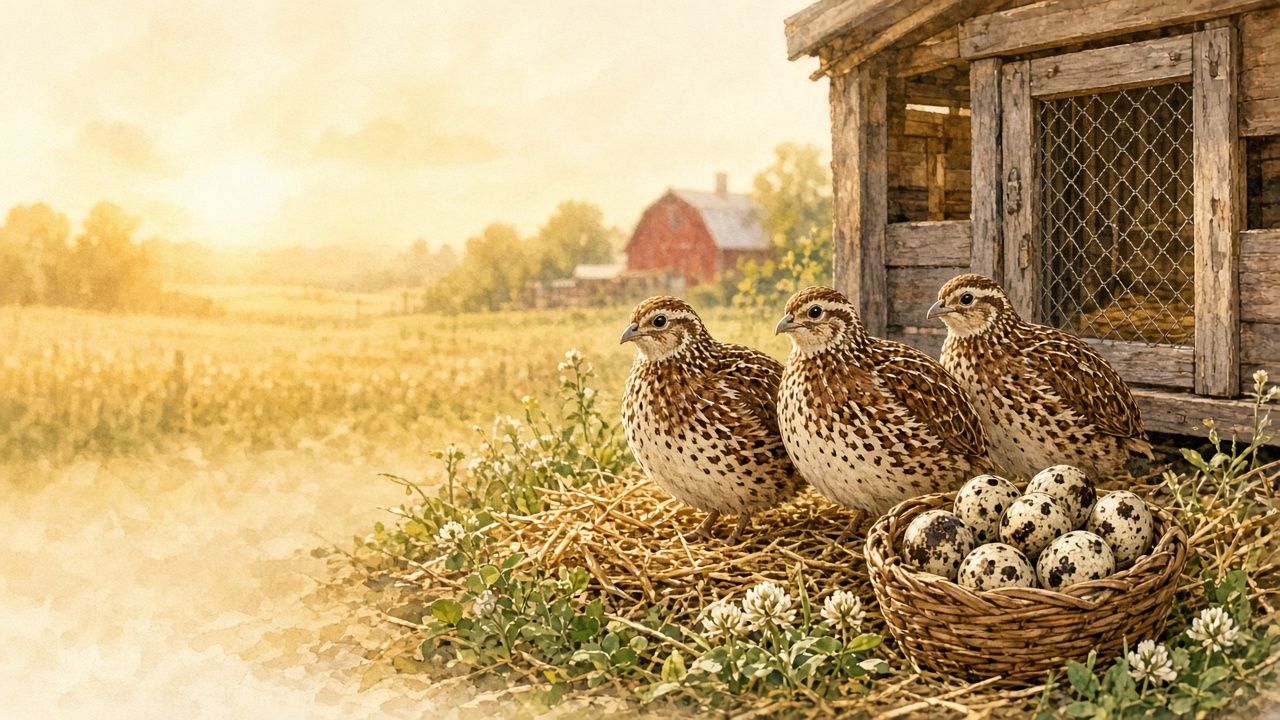
- Wild-type plumage is mostly dark cinnamon brown. Adult hens have pale breast feathers speckled with dark spots; adult males have an even rusty-red breast and cheeks. The difference shows up at about 3 weeks of age, not before [10].
- Hens are slightly heavier than males. Birds that have not been selected for size weigh about 100–140 g (males) and 120–160 g (females) [1]. A Japanese reference gives 100–130 g for males and 120–160 g for females, and 6–8 g for a day-old chick [10].
- Meat lines are much bigger: selection for meat has produced birds two to three times the weight of egg-type birds [10][2].
- In the wild, the Japanese quail is listed as Near Threatened on the IUCN Red List [48]. The common quail (C. coturnix) of Europe, Africa and western Asia looks very similar; the two overlap and can interbreed, and their exact taxonomic relationship has been debated [46].
A short history
- Japanese records of wild quail go back to the eighth century. The bird was semi-domesticated in the sixteenth century, kept first as a singing bird [10].
- From 1907 to 1941, Japanese breeders selected quail for egg production; about 2 million birds were kept by 1941. Most were lost during the Second World War, and the industry was rebuilt afterward from the few remaining birds, possibly with additions from Korea, China, Taiwan and wild-caught quail [10].
- Today Japan farms them mainly for eggs, while European breeders have selected them for meat [10].
- US scientists began promoting the Japanese quail as an experimental animal around 1959 [15]. It remains a common laboratory bird because it is small, eats little and matures fast [10].
- Sources disagree on how old domestication is. The University of California's game bird guide says Japanese quail have been raised in captivity "for thousands of years" and may have been confined longer than the chicken [2]. The Japanese reference above dates semi-domestication to the 1500s [10]. Egyptian hieroglyphs depicting Coturnix quail date back thousands of years [46], but that refers to the wild common quail, not proof of domestic Japanese quail. The short version: the Japanese quail was kept as a songbird in Japan by the 1500s and developed into an egg bird in the early 1900s.
Why homesteaders keep them
- They mature in about 6 weeks and are usually in full lay by 50 days of age [1].
- A well-kept hen should lay about 200 eggs in her first year [1].
- They thrive in small cages and are inexpensive to keep [1].
- Eggs hatch in about 17–18 days [1][2], so a hatch-to-laying-hen cycle takes roughly two and a half months (17–18 days of incubation plus about 6–7 weeks of growing; this is our arithmetic from the figures above).
- They are fairly disease-resistant, though they can catch common poultry diseases [1].
- In Indiana, coturnix do not need a Department of Natural Resources game breeder's license, unlike bobwhite quail [23] (see Laws).
- Lifespan is short. One extension source gives 2 to 2½ years [1]; a Japanese laboratory reference gives an average of 3–4 years and a maximum of 7 years for males [10]. Either way, plan on replacing layers regularly.
Your first steps
- Check the rules where you live. Indiana doesn't require a DNR license for coturnix [23], but town and county poultry ordinances vary. See Laws.
- Set up housing before birds arrive. A solid roof, secure wire and protection from cats, rodents and hawks [1]. See Housing.
- Buy the right feed. Chicks need about 24–25% protein starter, and never layer feed [1][2][3]. See Feeding.
- Plan your source. Hatch your own eggs (see Breeding & Incubation) or buy birds; birds or hatching eggs brought into Indiana need health paperwork [26].
- Start good habits. Biosecurity and record-keeping from day one; Indiana asks owners to keep 3 years of flock records [25]. See Health.
Sources for this page
Numbers in brackets throughout the page point to these sources. Many are university extension publications, government agencies or peer-reviewed studies.
- Randall, M. & Bolla, G. (2008). Raising Japanese quail (Primefact 602, 2nd ed.). NSW Department of Primary Industries. https://www.dpi.nsw.gov.au/__data/assets/pdf_file/0005/145346/Raising-Japanese-quail.pdf (full text also reprinted at https://www.thepoultrysite.com/articles/raising-japanese-quail-1)
- Ernst, R. A., Woodard, A. E., Vohra, P. & Cardona, C. Raising Game Birds (ANR Publication 8155). University of California Agriculture and Natural Resources. https://ucanr.edu/sites/default/files/2018-07/286690.pdf
- Mississippi State University Extension. Feeding Quail (Publication 2383). https://www.poultry.msstate.edu/pdf/extension/feeding_quail.pdf
- Mizutani, M. (2003). The Japanese Quail. In The Relationship Between Indigenous Animals and Humans in APEC Region. APEC. https://www.apec.org/docs/default-source/publications/2003/12/the-relationship-between-indigenous-animals-and-humans-in-apec-region-2003/toc/quail.pdf
- Sittmann, K., Abplanalp, H. & Fraser, R. A. (1966). Inbreeding depression in Japanese quail. Genetics 54(2):371–379. https://doi.org/10.1093/genetics/54.2.371
- Indiana DNR. Game Breeder's License Information. https://www.in.gov/dnr/fish-and-wildlife/files/fw-game-breeder-license-information.pdf
- Indiana State Board of Animal Health. Small Flock & Exhibition Poultry. https://www.in.gov/boah/species-information/avianbirds/small-flock-and-exhibition-poultry/
- Indiana State Board of Animal Health. Poultry Entry Requirements. https://www.in.gov/boah/species-information/avianbirds/poultry-entry-requirements/
- Animal Diversity Web (Univ. of Michigan). Coturnix coturnix (common quail). https://animaldiversity.org/accounts/Coturnix_coturnix/
- IUCN Red List. Coturnix japonica (Japanese quail). https://www.iucnredlist.org/species/22678949/218902058